EDITORIAL
RUSSIAN HISTORY
An empirical study is performed to examine the correlation between crisis-related experiences and academic motivation, involving four naturally set up groups of Physics majors from the Department of Experimental Physics at Surgut State University, aged 18–24. The research methods include psychological measurement using psychodiagnostic techniques described in “Questionnaire of Crisis Events and Experiences for Students” by V. R. Manukyan, “Motivations for Studying at a University” by T. I. Ilyina, a modified “Career Anchors” technique by E. Schein, and methods of mathematical statistics. A correlation is found between the nature of crisis experiences and students’ academic motivation: high severity and breadth of crisis experiences are observed in students with a combination of motivation for acquiring knowledge and mastering a profession, students motivated by obtaining a diploma experienced a crisis of hopelessness, and students motivated by acquiring knowledge experienced only minor crisis experiences.
The subject of the research is the professional biography of Ivan Dmitrievich Karyagin, Deputy People’s Commissar (Minister) of the oil industry of the USSR. Biography reflects not only the stages of work activity (as opposed to a professional career), but also various events, circumstances, motivations, associated with professional activity. The authors reveal how a person from an ordinary peasant family and rural hinterland participated in the industrialization events of the USSR, became one of the oil industry leaders, and contributed importantly to the victory in the Great Patriotic War. This article examines the circumstances of I. D. Karyagin’s arrival in the Tyumen province after many years of work in the capital and identifies his contribution to the creation of the USSR’s new fuel base. Using documents from the central archives of the Russian Federation, the authors employ a biographical research method. Key conclusions: the oil economist Ivan Karyagin, whose contributions have been partially neglected, was a crucial figure in the industry’s evolution throughout his career in Moscow and Tyumen.
The article examines the role of donations as a form of patriotic expression during the Patriotic War of 1812. This article explores an archival document detailing the material aid offered by the citizens of Tobolsk throughout the war. The article also explores the motivation of Siberians and the significance of their contribution to defending the Fatherland. Patriotism was fundamental in the formation of the Russian state. The population of Siberia provided significant support to the army. In 1812, Tobolsk residents raised 10,000 rubles to assist the Tsar and the army. Between 1812 and 1815, residents of the Tobolsk Governorate contributed more than 168,000 rubles to the army.
GENERAL PEDAGOGY, HISTORY OF PEDAGOGY AND EDUCATION
The relevance of the paper lies in the high demand for A. S. Makarenko’s legacy in modern pedagogical practice, the possibilities of reinterpreting its basic principles from the perspective of the technological approach. The author defines the education technology as the process of realization of the set educational objectives by the combination of its forms, methods, techniques and means that ensure the most effective results. The author’s classification of educational technologies developed in the theory and tested in practice by A. S. Makarenko is presented. The classification distinguishes 3 levels: general pedagogical, private methodological and specific. The structure of educational technologies of the general pedagogical level that includes the technology of formation and team building in children’s group, the technology of integral formation of the child’s personality in a residential establishment is described. Private methodological education technologies that make up the general pedagogical technology of children’s integral personality formation (aesthetic, labor, and military-patriotic education) are revealed. The article’s target audience is scientists who study the work of A. S. Makarenko, as well as students, pedagogical practitioners interested in the historical and pedagogical national legacy.
The article substantiates the pedagogical conditions for developing leadership qualities in university students. A model and a proprietary program implemented in an experimental study are proposed. Quantitative results and a statistical validation are presented. The data indicate the following regarding leadership qualities: the percentage of students exhibiting high levels increased to 48%, whereas those with low levels declined to 9%. The hypothesis is confirmed (t = 8.04, p < 0.001). The practical significance of the program lies in its feasibility for implementation in the educational environment of universities.
The article examines methodological approaches to assessing the effectiveness of cooperation between schools and businesses in the implementation of innovative educational projects. This study’s significance stems from the necessity of creating scientifically sound and practically useful tools for assessing social partnership outcomes, which are essential for updating the current educational system. The research is based on the premise that partnership projects implemented by schools in collaboration with enterprises significantly enhance the quality of education, adapt its content to labor market demands, and support the development of students’ cross-curricular, digital, and professional competencies. The aim of the study is to develop and substantiate a methodology for comprehensive evaluation of partnership effectiveness, covering not only resource and organizational dimensions but also educational, social, and innovative aspects. This article presents a classification of evaluation criteria, proposes a system of weighting coefficients, and explores the implementation potential of various methods, including the criteria-based evaluation method, SWOT analysis, logical-structural modeling, case analysis, and sociological monitoring. The results of the study support the working hypothesis that a scientifically grounded evaluation system contributes not only to more accurate management of innovative projects but also to the strengthening of trust between schools and businesses, increased transparency of processes, and enhanced results-orientation in the educational environment. Educational institutions, educational authorities, and business partners can adopt the proposed approaches during the planning, implementation, and monitoring of joint educational initiatives. Thus, this article contributes to the development of the theory and practice of social partnership in education and offers tools to improve the efficiency of cross-sectoral collaboration.
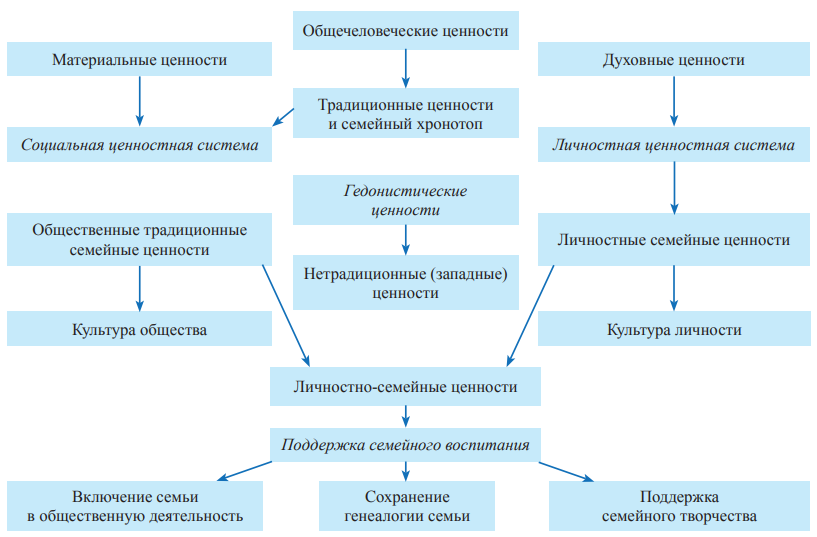
The paper presents a pedagogical support system for family education based on the traditional values combination as the means of countering the values dichotomy. The spirituality polarization trend substantiates the relevance of the topic, reflecting value systems imbalance in the individual and society modern culture, which has a significant impact on the personal and family values structure and family education. The purpose is to analyze the forms of pedagogical support for family education based on the traditional values combination. The scientific results are the development of a system for countering the values dichotomy through three main areas of supporting family education: protecting the family genealogy and traditions, involving the family in social activities and supporting family creativity during reflection of the family values dichotomy system, as well as in identifying value attitudes and social effects of cultural events. The authors' approach is to identify the connections of family education with the pentabasis and the principles of the family education concept. The academic novelty is in highlighting the directions of family education through a systematic approach. Recommendations on using measures to support family education in informal settings are offered. The research materials include regulatory documents of the Russian Federation President and the government on the preservation of family values, as well as the work of cultural institutions and extracurricular education
PHYSICAL EDUCATION AND PROFESSIONAL PHYSICAL TRAINING
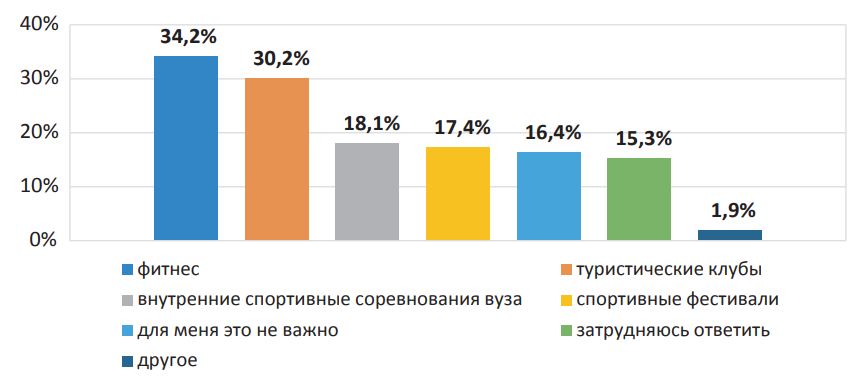
A goal of the physical education and sports development strategy is to cultivate motivation for physical education among university students. The aim of the study is to develop a program to increase motivation for physical education among university students. Research methods include a literature review, survey, testing, and modeling. After identifying motivation levels and testing students’ primary motivations, researchers developed an experimental program to increase motivation during physical education and sports activities. Performance indicators for the subprograms include average class attendance, certification in the “Elective Courses in Physical Education and Sports” course, the number of students participating in additional physical education sections (including independent study), and the level of student motivation for physical education.
The article reveals the ontological, axiological, methodological and praxeological foundations for developing an ecokinesiological approach to physical education of preschool children aimed at the comprehensive development of kinesiological potential through the integration of motor activity with cognitive, social and emotional development. The importance of the work is a result of modern societal challenges related to technological advancements, causing a reduction in preschoolers’ motor activity, which harms their physical, mental, and social growth, including a decline in kinesiological potential. The problem statement is associated with the need to overcome the movement deficit through the comprehensive development of psycho-bodily-motor characteristics considering the connection between cognitive functions and motor skills. Solutions include the creation of an enriched educational environment that takes into account modern challenges of technological advancements and individualization of education.
METHODOLOGY AND TECHNOLOGY OF PROFESSIONAL EDUCATION
The article examines the scientific and methodological support of teachers working with students of foreign origin in a foreign language environment. The aim of the study is to develop a comprehensive approach to supporting teachers aimed at overcoming professional deficiencies in working with students of foreign origin. Previous studies are content analyzed, and support areas are structured as a methodological basis. The authors identify four groups of teacher deficiencies: organizational and pedagogical, didactic, methodological, and psychological. To address these deficiencies, the authors propose a support model that includes training, consulting, adaptation, informational, psychological, and other areas. The novelty of this study lies in the development of topics for professional development modules, a methodology for developing differentiated assignments based on the SOLO taxonomy, a model for a personalized training program and support, and strategies for reflective practices. The main findings show that teachers need systemic support, which elevates education quality, encourages social integration and also enhances intercultural understanding. Additional education programs can implement the proposed tools and methods.